Trading Essentials
Build a solid foundation with core trading concepts, market mechanics, and fundamental analysis techniques that every successful trader needs to master.
Start Learning
What is quantitative trading?
Quantitative trading uses mathematical models, statistical analysis, and computer algorithms to identify and execute trading opportunities. Unlike discretionary trading, which relies on human judgment and intuition, quantitative approaches follow systematic, rules-based strategies that remove emotional bias from decision-making.
At its core, quantitative trading involves collecting vast amounts of market data, applying statistical techniques to identify patterns or inefficiencies, and then building automated systems to exploit those patterns. These systems can process thousands of data points per second, far exceeding human analytical capacity.
Modern quantitative strategies range from simple moving average crossovers to complex machine learning models that adapt to changing market conditions. The key advantage is consistency — a well-designed quantitative system executes the same strategy regardless of market sentiment or psychological pressure.
Key takeaways
- Rules-based execution eliminates emotional trading decisions
- Backtesting allows strategy validation on historical data before risking real capital
- Algorithmic systems can monitor multiple markets and timeframes simultaneously
- Statistical edge compounds over hundreds or thousands of trades
Understanding market orders
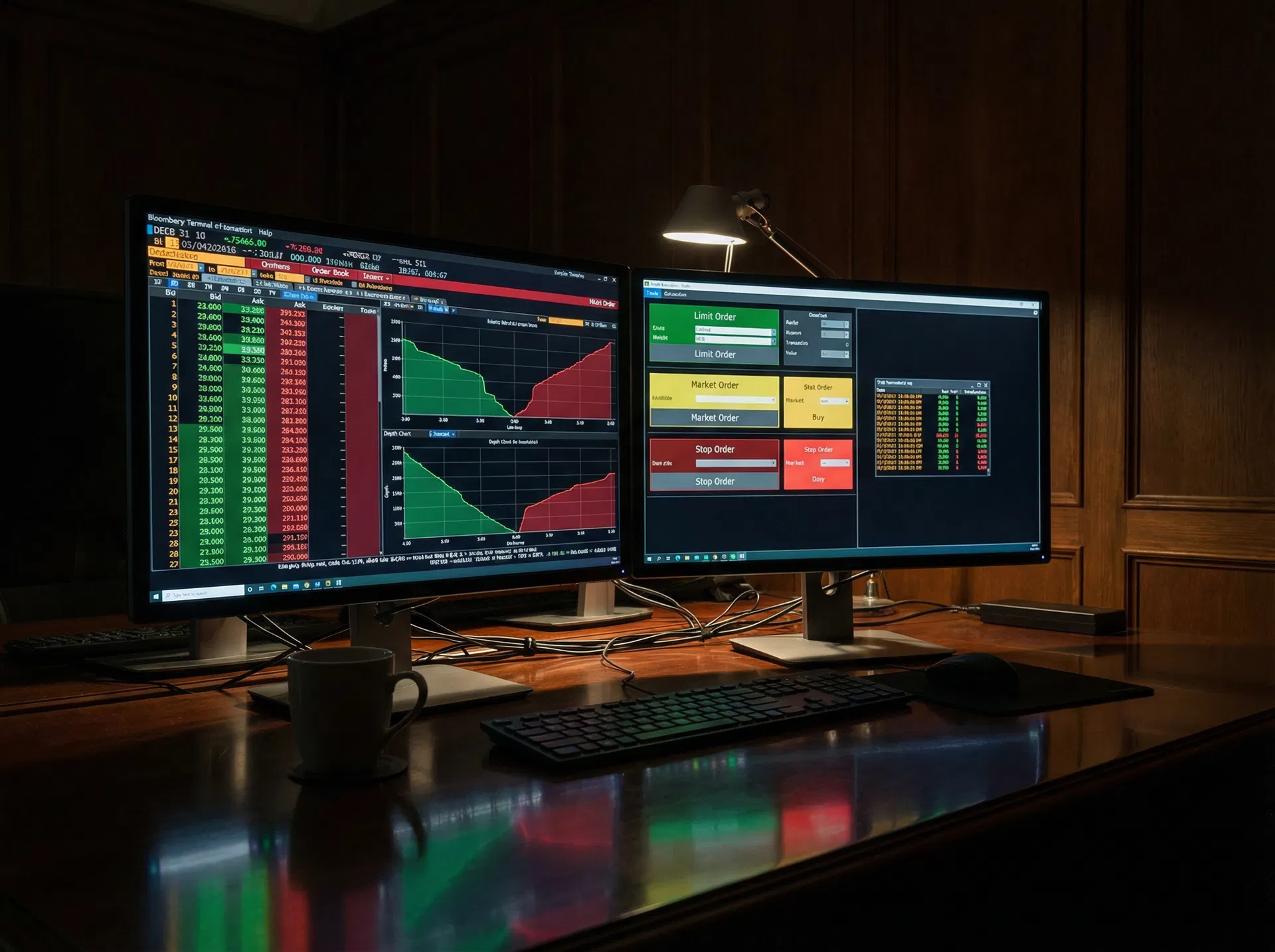
Market orders are the most basic type of trade instruction — they tell your broker to buy or sell an asset immediately at the best available price. While simple, understanding the nuances of different order types is essential for effective trading and risk management.
A limit order allows you to specify the maximum price you are willing to pay (for a buy) or the minimum price you are willing to accept (for a sell). This gives you price control but does not guarantee execution, as the market may never reach your specified price.
Stop orders, including stop-loss and stop-limit orders, are critical risk management tools. A stop-loss order automatically closes your position when the price reaches a predetermined level, limiting potential losses. Understanding when and how to use each order type is fundamental to protecting your capital.
Key takeaways
- Market orders guarantee execution but not price
- Limit orders guarantee price but not execution
- Stop-loss orders are essential for automated risk management
- Trailing stops can lock in profits while allowing positions to run
Introduction to technical analysis
Technical analysis is the study of historical price and volume data to forecast future market movements. It operates on the principle that all relevant information is already reflected in the price, and that price patterns tend to repeat over time due to consistent human psychology.
Chart patterns such as head and shoulders, double tops and bottoms, and triangles provide visual representations of the battle between buyers and sellers. These patterns, when identified correctly, can signal potential trend reversals or continuations.
Technical indicators — including moving averages, RSI (Relative Strength Index), MACD (Moving Average Convergence Divergence), and Bollinger Bands — provide quantitative measurements of price momentum, trend strength, and potential overbought or oversold conditions. Combining multiple indicators can improve signal reliability.

Key takeaways
- Support and resistance levels identify key price zones where buying or selling pressure concentrates
- Moving averages smooth price data to reveal underlying trends
- Volume analysis confirms the strength of price movements
- Combining indicators reduces false signals and improves trade timing
Related guides
Risk Management
Learn professional-grade techniques for capital preservation and position sizing.
Explore →